( SHORT TERM, MID TERM, and ONE YEAR PROFESSIONAL DIPLOMA PROGRAM )
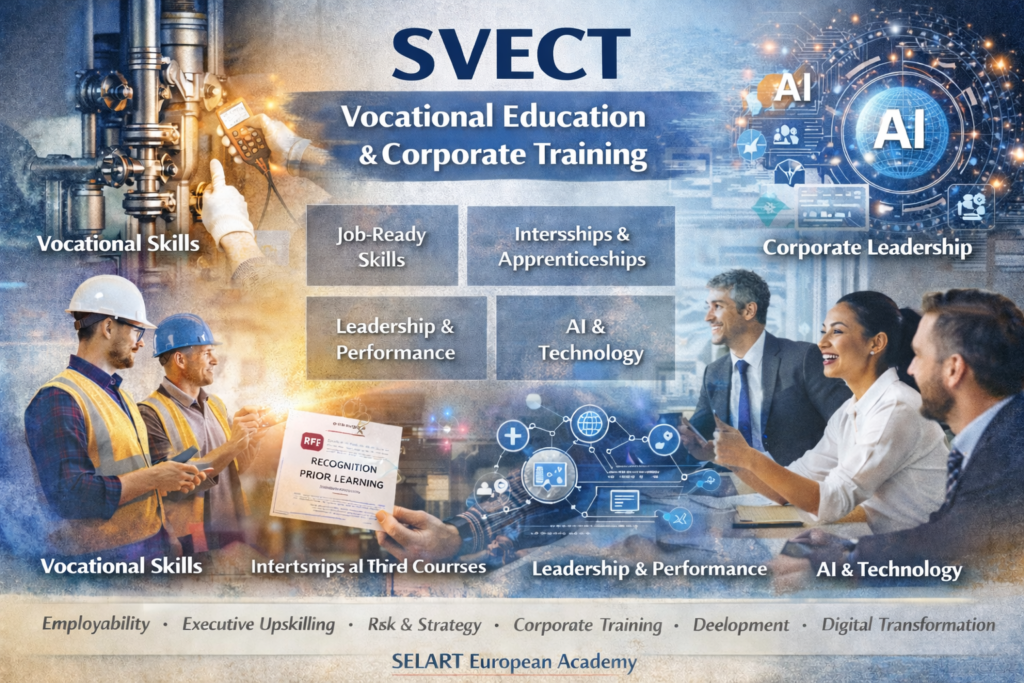
SELART European Academy offers the SVECT (SELART Vocational Education & Corporate Training) the pedagogical pillar as a practical, industry-connected learning pathway delivered in flexible formats: online, hybrid, and face-to-face (offline). Programs are available in different durations, short-term, mid-term, and one-year formats, so adults, young professionals (18+), and organizational teams can choose the learning intensity that best matches their goals, schedules, and career or performance needs. SVECT connects training to real-world industries by offering job-ready vocational programs for learners who want to enter the job market, improve employability, change careers faster, or progress in a specific vocation. It also serves executives and professional teams across non-education sectors (corporate, governmental, NGOs, and private/public institutions) through practical, performance-driven corporate trainings.
Why SVECT Pedagogical Pillar is needed
SVECT is established to respond to real workforce needs and fast-changing industry expectations:
- Many passionate lifelong learners need job-ready skills quickly, with practical training and certificates that employers trust.
- Employers value candidates who can perform real tasks, not only explain theory.
- Industries evolve rapidly; vocational programs must be continuously updated (tools, procedures, technology, regulations, workplace expectations).
- Strong vocational pathways improve employability, productivity, and career mobility.
- Organizations need continuous professional development to lead in disruption (technology shifts, market volatility, regulatory change, stakeholder pressure).
- Modern leadership requires adaptive pathways (agile, adaptive, transformational, systems, servant leadership) to sustain change and performance.
- Many initiatives fail due to weak execution and change adoption; SVECT strengthens leaders’ ability to implement improvements with measurable results.
- AI and technology are reshaping competitiveness; leaders need practical capability to choose high-value use cases and scale responsibly with governance, privacy, and security.
- Senior teams face high-stakes decisions (finance, contracts, cyber risk, service reputation); SVECT equips them with usable tools to protect value and reduce risk.
Mission, Vision, and Identity
Mission
To deliver industry-relevant vocational education and corporate trainings that build verified competence, accelerate employability, and improve organizational performance through measurable, practice-based learning.
Vision
To become a trusted regional and international hub for job-ready vocational qualifications and executive upskilling, recognized for quality, practicality, and strong industry alignment across the SELART global network.
Identity and core values
- Industry-aligned and outcome-driven
- Competency-based with verified performance
- Ethics, safety, and professional standards
- Continuous improvement and innovation (including responsible AI)
- Learner-centered support with high expectations
- Partnership and co-creation with employers
Scope and boundaries
- SVECT focuses on vocational and corporate training for non-education sectors.
- SVECT does not deliver educator training (teacher pedagogy, curriculum delivery, inquiry facilitation, school academic leadership). These fall under EFD.
- Licensing-regulated programs (e.g., safety, healthcare) are offered only where local legal requirements, accredited partners, and approved trainers are in place.
Target groups
- Adults (18+) and young professionals seeking rapid employability or career transition.
- Employees who need upskilling/reskilling for new tools, systems, and roles.
- Executives and managers needing practical leadership, execution, finance, contract, risk, and digital/AI capability.
- Corporate/Government/NGO teams requiring customized training for performance improvement.
Program architecture and credentials
- Short-term intensive courses: 2 days to 4 weeks (micro-credentials / certificates).
- Mid-term professional tracks: 6 to 16 weeks (professional certificates, portfolio-based).
- One-year vocational diplomas: 9 to 12 months (capstone, internship/field project, strong portfolio).
- Corporate trainings: customized 1–5 day workshops and blended programs (workshop + coaching + on-the-job projects).
- Recognition of Prior Learning (RPL): assessment-based pathway with gap training for experienced candidates.
Learning model and delivery modes
SVECT uses competency-based training. Passionate Lifelong Learners demonstrate what they can do through practical performance tasks, projects, simulations, labs, and portfolios.
Learning hours policy (contact, guided, individual)
- Contact / live instruction time counts at 100% of scheduled hours.
- Guided and mandated learning time (supervised practice, coached labs, mentored projects) counts at 100%.
- Individual learning time (assigned tasks, independent practice, portfolio building) is included at a minimum of 50% of its allocated hours, with clear evidence requirements (deliverables, logs, assessments).
Delivery formats
- Online (live + asynchronous activities) and hybrid (online + face-to-face practical sessions).
- Workshops, labs, simulations, case-based learning, field projects, and on-the-job assignments (for corporate clients).
- Internships/apprenticeships and site visits (where applicable and feasible).
Quality assurance and continuous improvement
- Program design aligned to job roles, task analyses, and (where relevant) industry standards and external certification requirements.
- Trainer qualification requirements and continuous trainer development.
- Assessment integrity: practical exams, demonstrations, rubrics, portfolios, and external moderation when needed.
- Regular market review: employer feedback, tool updates, regulatory changes, and graduate outcome tracking.
- Learner support: onboarding, study skills, career readiness, and mentoring for portfolio/capstone work.
- Data protection and ethical AI use in learning activities and corporate engagements.
Main objectives
A. Vocational education objectives
- Offer short-term, mid-term, and one-year vocational programs for adults and young professionals in specific job roles.
- Align each program to real workplace tasks, tools, and industry expectations.
- Deliver employability-focused certifications with clear competency outcomes and evidence.
- Apply competency-based training: learners prove skills through performance.
- Provide hands-on learning via labs, workshops, simulations, and field projects.
- Require supervised practice hours to build safe and correct professional habits.
- Use performance-based assessment (demonstrations, practical exams, portfolios).
- Prepare learners for external certification/licensing exams where relevant.
- Develop workplace readiness skills (communication, teamwork, punctuality, ethics, professionalism).
- Integrate profession-specific digital and AI tools as workplace productivity and quality tools with responsible use.
- Offer RPL and fast-track pathways for experienced candidates through assessment and gap training.
- Build industry partnerships for internships/apprenticeships, site visits, guest experts, and co-assessment.
- Maintain continuous program updates based on market change, new tools, and employer feedback.
- Track outcomes (completion, certification success, employability feedback) to continuously improve programs.
- Provide portable evidence of competence (certificate, portfolio, work samples, and assessment records).
B. Corporate and executive training objectives
- Build future-ready leadership capability by equipping executives with practical tools to lead reinvention and sustain performance.
- Install a strategy-execution cadence (OKRs/KPIs, reviews, accountability) that keeps transformation tracked and sustained.
- Enable fast decision-making without losing alignment and control across teams and functions.
- Train leaders to select AI use cases that deliver value and to stop pilots that do not create measurable impact.
- Scale AI responsibly with trust, governance, privacy, and security guardrails (executive oversight).
- Rebuild workforce capability through reskilling/upskilling for new technologies and redesigned work models.
- Strengthen resilience by reducing dependency risk and improving supply chain / technology resilience.
- Make sustainability profitable by designing measurable ROI initiatives and performance metrics.
- Strengthen negotiation and deal strategy using structured tools (BATNA, ZOPA, red lines, concessions, ethical influence).
- Protect agreements through robust contract design (SLAs, penalties, acceptance criteria, governance, escalation, exit triggers).
- Control hidden contract risks (scope control, change orders, data/IP ownership, confidentiality, dispute resolution).
- Upgrade financial command skills (income statement, balance sheet, cashflow) and identify red flags requiring leadership action.
- Improve cash discipline and unit economics (profit vs. cash, 13-week cash forecast, contribution margin, break-even, pricing discipline).
- Reduce fraud and compliance exposure through leader-friendly internal controls and audit readiness.
- Prepare leaders for cyber crises: lead the first 24–72 hours, protect critical assets, run tabletop decisions, demand vendor accountability.
- Protect reputation through service excellence: journey mapping, repeat-failure fixes, escalation protocols, service recovery mastery.
- Deliver professional development in modern leadership pathways for complex and rapidly changing environments.
- Train leaders to manage change and resistance using stakeholder mapping, communication plans, readiness checks, and sustainable implementation.
- Develop decision and problem-solving capability under uncertainty using scenario planning and data-informed leadership.
- Strengthen innovation and continuous improvement culture with experimentation, learning, accountability, and measurable performance gains.